SCHADS Schedule E is confirmed for 1 December. Your planning window is now defined.

Three not-for-profit leaders reviewing financial insights together on a laptop

On 11 September 2026 the Fair Work Commission issued its final decision and determination on Schedule E of the Social, Community, Home Care and Disability Services Industry Award. The interim increase of about 15% for home care employees performing disability care is confirmed. The start date has moved from 1 October 2026 to 1 December 2026, and the remaining increase follows on 1 October 2027 when the new classification structure commences. The NDIS price schedule still sets a ceiling on what many providers can claim. A service can be busy, fully rostered and still consume unrestricted reserves if its delivered-hour economics no longer work.

The test is contribution margin by service line: claimable revenue for each delivered hour, less every cost required to deliver that hour. Include ordinary wages, penalties, allowances, leave, superannuation, travel, supervision, training, administration attached to delivery and the cost of cancellations. Rank services by margin percentage and weekly cash effect before deciding what to redesign, renegotiate, reduce or exit safely.

The figure is no longer provisional. The rates are published, the date is fixed and the path through to October 2027 is set out in the decision. The two-month deferral is not relief. It is a planning window, and providers now have a confirmed timetable to work to: the December increase first, then the October 2027 transition. A provider that waits until the December pay period lands will be reshaping rosters, service agreements and exposure under time pressure, with participants and staff absorbing the disruption.

What the Commission actually decided

Two documents matter. The decision [2026] FWCFB 232 and the determination PR814259, both issued on 11 September 2026.

  • The interim increase of about 15% for employees engaged under Schedule E now commences on 1 December 2026, deferred from 1 October 2026.
  • It does not apply to a given employee until the start of their first full pay period beginning on or after 1 December 2026. For most providers that is a date in early December, not 1 December itself.
  • The uplift is not 15% for everyone. Employees currently classified at Level E.4.2 receive 14.96% and Level E.5.2 receive 13.31%.
  • The remaining increase applies on 1 October 2027, when the new classification structure commences. The size of that step depends on which translation table an employee falls under. Work translating as home care disability work (Schedule B.8) sits between 1.97% and 6.97%, median about 3.7%, which is the range the Commission cites at paragraph [168]. Work translating as disability support work (Schedule B.7) runs materially higher, up to about 17% on top of the December rate. The Commission decided against a second interim step, so this is a two-date sequence, not three.
  • The Commission deferred the start date because no funding commitment has been made by the Commonwealth, and because providers need time to renegotiate with funders and clients. The wage cost is locked. The funding to meet it is not.

The new Schedule E weekly rates for a full-time home care employee performing disability care, operative from the first full pay period on or after 1 December 2026:

Classification Weekly rate
Level 1, pay point 1 $1,192.30
Level 2, pay point 1 $1,261.10
Level 2, pay point 2 $1,269.70
Level 3, pay point 1 (certificate III) $1,287.00
Level 3, pay point 2 $1,326.80
Level 4, pay point 1 $1,404.20
Level 4, pay point 2 $1,431.70
Level 5, pay point 1 (degree or diploma) $1,505.60
Level 5, pay point 2 $1,541.90

Before you model anything, answer the prior question: which of your shifts sit under Schedule E and which sit under Schedule B? The December increase applies to employees currently classified under Schedule E. Because disability support work has historically been classified under both Schedules B and E, providers should verify each employee’s existing classification rather than relying on job title or service description. Many providers cannot answer this cleanly from their own roster data, and the answer determines the size of the December cost step.

Then note that the definition inverts on 1 October 2027. Schedule E is abolished. Personal care for a person with a disability becomes disability support work in the social and community services stream regardless of where it is performed, including in a private residence. Home care disability work is reduced to domestic assistance and home maintenance only. So the December question is Schedule E or Schedule B, and the 2027 question is personal care or domestic assistance. Most rosters are not coded for the second one.

Start with revenue per delivered hour

Use the applicable NDIS support item and current price limit for each service. The limit is a ceiling, not proof that the service is viable. Check whether the service is billed hourly, by shift, by group, with a travel component or under another permitted unit.

For each service line, calculate:

Claimable revenue per delivered hour = total valid claims for the period ÷ participant-facing hours actually delivered.

Do not divide by rostered hours. Cancellations, unfilled shifts, non-claimable travel and gaps between appointments can leave paid time without matching revenue. Delivered hours show what the organisation was able to claim for work that occurred.

Reconcile the calculation to actual claims, not a price-guide spreadsheet. Your bookkeeping foundation needs service codes, support items and labour costs recorded consistently. Otherwise, management is comparing a theoretical price limit with an incomplete cost number.

The delivered-hour margin test
Worked example at $70 claimable per delivered hour. Illustrative figures, not NDIS price limits.
Claimable revenue
$70.00
Wages and penalties
−$42.00
Leave and superannuation
−$8.40
Travel and kilometres
−$4.80
Supervision and coordination
−$5.60
Cancellations and unfilled time
−$3.20
Contribution today
$6.00 · 8.6%
After the confirmed +15% December rise the same hour loses $0.30 before overhead, and leave and super flow-ons push it further.

Put every labour cost into the test

The wage rate is only the first line. Build the cost stack from payroll and roster records:

  1. ordinary wages by classification;
  2. evening, weekend, public-holiday and overtime penalties;
  3. allowances that apply to the work;
  4. annual leave, personal leave and long-service leave accruals;
  5. superannuation and payroll tax where applicable;
  6. workers compensation insurance;
  7. paid travel between participants and kilometres not separately recovered;
  8. supervision, handover, training and required documentation;
  9. rostering and service coordination directly attached to delivery; and
  10. paid cancellations, short-notice gaps and unfilled time.

Use actual roster mix. A weekday base-rate average hides services delivered on weekends or by employees at different classifications. Your payroll process should let finance reconcile paid hours and on-costs to the service-line view.

Contribution margin means the revenue left after costs that move with delivery. It is not the organisation’s final surplus. Rent, governance, finance, technology and general leadership still have to be funded from what remains.

A worked example shows where the pressure sits

Suppose one service can claim $70 per delivered hour. This is an illustrative figure, not an NDIS price limit.

  • Direct wage and penalties: $42.00
  • Leave and superannuation: $8.40
  • Travel and kilometres: $4.80
  • Supervision and service coordination: $5.60
  • Cancellations and unfilled paid time: $3.20
  • Total delivery cost: $64.00
  • Contribution per delivered hour: $6.00
  • Contribution margin: 8.6%

If the relevant direct wage component rises by 15%, the $42 line becomes $48.30 before any flow-on effect to leave or superannuation. The service moves from a $6.00 contribution to a loss before overhead. The exact result depends on employee classification, roster mix and claim rules, and the uplift is lower for employees at Levels E.4.2 and E.5.2.

That is the trap. Applying 15% to the whole cost base overstates the direct calculation. Applying it only to the base hourly rate understates the flow-on cost. Model the affected wage components, then recalculate related on-costs. Now that the determination is published, work from the actual new rate for each classification rather than a blanket percentage. The 15% is a headline, not an input.

Rank services by percentage and weekly cash effect

A low percentage matters, but volume determines how quickly it reaches the bank account. Put both measures on one page.

Service line Revenue per delivered hour Cost per delivered hour Contribution margin Weekly delivered hours Weekly contribution
Service A actual actual calculated actual calculated
Service B actual actual calculated actual calculated
Service C actual actual calculated actual calculated
Protect
Positive margin and material weekly contribution.
First move: hold coding and claim discipline; grow delivered hours.
Repair
Thin margin with a workable redesign path.
First move: reshape roster, travel and group mix; re-test monthly.
Act now
Negative margin or rapid weekly cash drain.
First move: assign an owner, a due date and one of the four action paths.

Add one more column: confidence in the data. A line with clean claims, payroll and roster coding can support a decision. A line built from broad averages needs investigation first. Reporting and insights should show the calculation beside actual results each month, with exceptions investigated rather than averaged away.

Run three cases, then look at 2027

The December rates are settled, and the October 2027 classification structure and transition are now defined. What is left to model sits mainly in funding, roster mix and utilisation, plus the 2027 dollar rates once the 2027 Annual Wage Review is applied.

Case 1: current rates

Keep current wage rates and current delivered-hour patterns. This is the baseline and should reconcile to recent actuals.

Case 2: confirmed December rates

Apply the published Schedule E rates to affected classifications from the first full pay period on or after 1 December 2026, and recalculate leave, superannuation and other linked costs. Hold the current NDIS claim limit unless an official update says otherwise. The Commission has not been given a funding commitment, so assuming price relief is a decision you should make consciously rather than by default.

Case 3: operational stress

Use the December rates, then add a realistic deterioration in cancellations, travel recovery or roster utilisation. This shows which service lines only work when every operational assumption lands perfectly.

Then extend the horizon to October 2027

The remaining increase accompanies the new classification structure from each employee’s first full pay period starting on or after 1 October 2027, alongside the translation of employees into that structure and the revocation of the equal remuneration order. Model both translation paths rather than one blended figure: currently around 1.97% to 6.97% where the work translates as home care disability work, and up to about 17% where it translates as disability support work. Treat both as provisional, because the final 2027 dollar rates will be updated for the 2027 Annual Wage Review. A service line that is marginal after December will not recover on its own. Carry the second step into the same model now, while there is time to do something about it.

For each case, show contribution margin, weekly cash effect and the date unrestricted cash crosses the board’s minimum threshold. Put the assumptions beside the result.

Give every weak service line an action

The spreadsheet is not the decision. Each weak line needs an owner, a due date and one of four action paths.

Redesign
When: the cost problem is roster-shaped.
First move: Change roster shape, geography, group mix or scheduling while protecting participant outcomes.
Renegotiate
When: terms, not delivery, set the loss.
First move: Review valid funding, service agreements, travel recovery and contract terms.
Reduce exposure
When: the economics may improve but not yet.
First move: Cap growth or redeploy capacity until the delivered-hour numbers recover.
Exit safely
When: no workable path exists.
First move: Plan an orderly transition covering participant continuity, workforce obligations and notice.

Financial modelling does not decide what is lawful, clinically appropriate or fair to participants and employees. Confirm award interpretation and employment obligations with qualified HR or legal advisers. Confirm current NDIS pricing and claiming rules from official sources.

Some services may be retained despite a weak standalone margin because they are essential to participant outcomes or connected to a viable service pathway. Make that subsidy explicit. Name its weekly cost, funding source and review date. Hidden cross-subsidy is how mission decisions turn into cash surprises.

What to do between now and 1 December

This is the part that changed most. The interim date was provisional until 11 September, so many providers were waiting. There is now a defined window, and it is long enough to act in and short enough to matter.

  • By the end of September. Separate Schedule E work from Schedule B work in your roster and payroll data. Build the first service-line table and reconcile valid claims to participant-facing hours actually delivered.
  • By mid-October. Load the full labour stack from payroll and rosters, including penalties, allowances, leave, superannuation, travel and paid cancellation time. Apply the published December rates by classification.
  • By the end of October. Run the three cases and the 2027 horizon. Rank every service line by contribution margin and weekly cash effect, and note your confidence in the underlying data for each one.
  • Through November. Give each weak line an owner, a decision date and one of the four action paths. Renegotiation of service agreements and funder conversations take longer than roster changes, so start those first.
  • First full pay period on or after 1 December. New rates apply. Reconcile the first full pay run against your model and investigate the variance while it is small.

The first version of the table will expose missing coding and operational data. Fixing those gaps now is part of the work, and it is the part that cannot be done in the last fortnight.

If your team needs a clean reporting foundation and a partner to turn it into decisions, book a discovery call.

Frequently asked questions

Is the SCHADS Schedule E rise final?

Yes. The Fair Work Commission issued its final decision and determination on 11 September 2026. The interim increase commences on 1 December 2026, deferred from 1 October 2026, and applies from each employee’s first full pay period starting on or after that date. Employees at Levels E.4.2 and E.5.2 receive 14.96% and 13.31% rather than 15%. Confirm your own classifications and obligations with qualified workplace advisers.

What happens on 1 October 2027?

The new classification structure commences on 1 October 2027 and takes effect for an employee from the first full pay period starting on or after that date. Schedule E is abolished at that point. Personal care for a person with a disability becomes disability support work wherever it is delivered, and only domestic assistance and home maintenance remain home care disability work. The two paths translate differently: currently about 1.97% to 6.97% for home care disability work, median about 3.7%, and up to about 17% for disability support work, both measured on top of the December rate. Final dollar rates will reflect the 2027 Annual Wage Review. There is no second interim step before then.

Does the deferral mean funding has been sorted out?

No. The Commission deferred the start date partly because no funding commitment had been made by the Commonwealth and providers need time to engage funders and renegotiate service agreements. The wage obligation is now fixed. Any price relief is a separate question and should not be assumed in a model.

Which NDIS price limit should a provider use?

Use the current official price limit for the exact support item, location, delivery setting and participant circumstances. Use actual valid claims to calculate realised revenue per delivered hour.

What is contribution margin by service line?

It is service revenue less the costs directly required to deliver that service. It shows what remains to fund organisation-wide overhead and reserves. It is not the final operating surplus.

Should travel and cancellations be included?

Yes. Include paid travel, unrecovered kilometres, paid cancellation time and unfilled roster gaps. Separate amounts that are validly claimable so revenue and cost are not double counted.

Can a provider keep a loss-making service?

Yes, where leadership makes an explicit mission decision and identifies how the service will be funded. Record the weekly subsidy, source of unrestricted funds and review date rather than allowing an invisible cross-subsidy.

The figures in this article are illustrative and are not financial, workplace or legal advice. Award rates, NDIS price limits and claiming rules can change. Confirm current settings with official sources and qualified advisers. Contribution margin depends on accurate service, claim, roster and payroll data, and does not include every organisation-wide overhead.

Superannuation in 2026: What Australian Employers Need to Know

Since 1992, it’s been a legal requirement for Australian employers to pay superannuation into their employees’ retirement funds. While the required contribution rate has increased gradually over time, it reached 12% in July 2025 and is now set at its maximum level.

However, from 2026, employers will need to meet new requirements related to the timing and administration of super payments. This means businesses need to be more organised than ever, as paying the correct amount, for the right people, and on time is non-negotiable for remaining ATO-compliant.

In this article, we’re going to explain how superannuation works, what your obligations are, what key deadlines you need to be aware of in 2026, and when to turn to superannuation services for support.

What is superannuation in Australia?

Superannuation, often referred to as “super”, is Australia’s retirement savings scheme. It’s designed to help people build long-term savings by having a percentage of their income paid by their employer into a nominated investment fund.

The goal of the scheme is to help employees build a reliable source of income for retirement, rather than relying solely on the Age Pension. In some cases, individuals can also access part of their super early, such as through the first home super saver (FHSS) scheme.

For employers, super contributions are a mandatory obligation, with strict rules around who must be paid and when. Generally, if you employ staff on a full-time, part-time, or casual basis, you’re required to pay super. You may also need to pay super for contractors who are paid mainly for their labour, even if they operate under an ABN.

Changes to Australian superannuation in 2026

While the contribution rate will be 12% for the foreseeable future, there are two major changes employers need to be aware of that will affect how super is paid and managed.

Here’s what you need to know to remain compliant.

Introduction of Payday Super

Beginning on 1 July 2026, employers will be required to pay super at the same time they pay salary and wages, rather than quarterly. This means that super contributions must be received by the employee’s super fund within seven business days of payday. This change in rules increases the need for accurate payroll data and reliable systems that help you avoid any late payments.

Closure of the Small Business Superannuation Clearing House (SBSCH)

The SBSCH is a free ATO-run tool that lets small businesses pay super for all employees in one place, instead of paying each superannuation fund separately. As part of the Payday Super reforms, this service will close permanently on 1 July 2026. This means that any existing users will need to move to another solution before the service is retired. This could be payroll software like Xero or MYOB, a super fund clearing house, or a third-party provider.

Super mistakes employers should avoid

Super is one of those areas where you can’t afford to make a mistake. Luckily, if you set up the right systems, it can be simple to stay compliant. Here are some common mistakes that you can avoid at the start of setting up your payroll that will save you headaches in the long run.

Paying super late (even by one day)

Paying super one day late might seem like a small slip-up, but in the eyes of the ATO, even a short delay can trigger the super guarantee charge (SGC). This charge includes interest and administration fees and is not tax-deductible. In practice, this usually means a $20 administration fee per employee, plus interest charged at 10% per year on the amount owed.

To avoid this penalty, enlist the support of a payroll service and invest in software that can calculate super correctly and run payroll for you.

Making incorrect ordinary time earnings (OTE) calculations

OTE includes employees’ wages, shift allowances, commissions, and bonuses. You need to ensure that super is being calculated on the employee’s full OTE, not just their base salary.

Misunderstanding what the 12% should be applied to can lead to underpayments over time. Regularly reviewing your pay items and checking them against ATO guidance can help ensure you’re paying the correct amount.

It’s also important to note that OTE doesn’t include overtime payments and expense reimbursements, so leave these out of the equation.

Missing super for eligible contractors

Many businesses don’t initially realise that Australian-based contractors who are paid primarily for their labour may still be entitled to super, even if they invoice under an ABN.

If your business fails to assess these contractor arrangements properly, this can result in unpaid super liabilities.

When reviewing contractor agreements, look at how the work is set up. For example, are you paying for a result and allowing the contractor to send someone else to do the work, or are you paying a specific person to do the work themselves? If this isn’t clear, your accountant or payroll provider should be able to help confirm whether super needs to be paid.

Poor record-keeping

Poor record-keeping and the ATO are a bad combination. In the rare (but possible) chance that you’re audited, you’ll need to have all your records organised and ready to hand over.

If you do have incomplete or inaccurate records, this makes it harder to prove compliance, and if any mistakes are found, this could lead to penalties.

We recommend always keeping clear payroll reports, payment confirmations, and employee fund details in a software platform so you have them ready in the event that the ATO audits your business.

Not checking stapled funds for new employees

Before setting up a default super fund for a new hire, make sure to check the ATO portal to see if the employee has a stapled fund. A stapled fund is simply the employee’s existing super fund, which stays with them when they change jobs.

Skipping this step can result in contributions being paid to the wrong fund, which is both a compliance issue and a source of added stress for your employee.

When businesses get super payments wrong

Mistakes do happen, and getting super wrong doesn’t usually lead to immediate penalties, but it can create ongoing compliance issues that take time and effort to fix.

Here are four key things employers should be aware of if mistakes do occur:

  • Super guarantee charge (SGC): If super is paid late or incorrectly, the ATO can apply their SGC. This charge includes the unpaid super amount, interest, and an administration fee, even if the super is eventually paid.
  • Loss of tax deductibility: Unlike normal super contributions, payments made under the SGC are not tax deductible. This means mistakes can cost more than just the original super amount.
  • ATO audits and compliance reviews: The ATO regularly reviews payroll and super data. Any errors can trigger compliance checks, requests for records, or follow-up action to confirm contributions have been paid correctly. This can be time-consuming and lead to penalties if they find clear wrongdoing.
  • Administrative time and stress: Fixing super issues often involves recalculating payments, gathering records, lodging forms, apologising to employees, and responding to ATO enquiries. This creates a whole bunch of unnecessary admin work and distraction for business owners and payroll teams.

In short, one mistake will cost you an admin fee and a 10% interest charge, and it will make the contribution ineligible as a tax deduction. However, longer patterns of missed or late payments are more likely to trigger audits and penalties from the ATO.

Choosing the right level of support

Since super rules have become stricter and payment timing has tightened, many employers are reaching a point where managing payroll in-house feels risky.

When this pressure starts to kick in and the paperwork begins to pile up, it’s a good idea to invest in support.

The right level of support depends on the capabilities you have in-house. For example, if you already work with an accountant or bookkeeper, payroll software may be enough to automate super calculations and payment timing.

However, if you’re looking for more hands-on support, a payroll service may be the better option. These services can support your business by:

  • Calculating super correctly across wages, allowances, bonuses, and commissions
  • Ensuring super is paid on time and in line with current rules
  • Keeping payroll and super records organised and audit-ready
  • Managing updates, such as stapled funds, and changing compliance requirements
  • Reducing the time and admin involved in running payroll each pay cycle

For growing Australian businesses, using a payroll provider can help reduce compliance risk while freeing up time to focus on running your operations.

If you’re curious about how a payroll provider could help your business, book a no-obligation call with our team to get started.

Simplify superannuation compliance with Visory

Super compliance is a core responsibility for Australian employers, and from 2026, getting it right relies on prompt payments and clear record-keeping.

While the ATO rules are strict, managing super doesn’t need to be complicated when the right systems and support are in place.

At Visory, we work with businesses that want added certainty and help take care of super calculations, payments, and reporting, all while reducing compliance risk and administrative load.

If you’d like support managing your super obligations, explore our payroll services. To learn more about how we could support your business, you can also book a call with our team.

FAQs

What employees do I need to pay super for?

Businesses need to pay super for any employees who are full-time, part-time, casual, and in some cases, contractors.

You may even need to pay super for contractors who invoice under an ABN. Typically, contractors who are paid primarily for their labour and are required to perform the work themselves will need to be paid super.

What happens if a business pays super late?

If you pay super late, even by a day, you will be charged by the ATO. This penalty is called the super guarantee charge and includes the unpaid super, 10% yearly interest, and an administration fee. Plus, the payment will no longer be tax-deductible.

When does Payday Super start in Australia?

Payday Super starts on 1 July 2026. From this date, super must be paid at the same time as wages, rather than quarterly.

What is the super rate in Australia?

As of 2026, the superannuation guarantee rate is 12% and will stay at this rate for the foreseeable future.

How often must an employer pay super?

From 1 July 2026, employers will need to pay super with each payday. This change was introduced to help employees receive super earlier so they can earn more interest over time, and to reduce the risk of unpaid or late super contributions.

Do employers have to pay super on all hours worked?

Super is paid on ordinary time earnings (OTE), which generally includes the employee’s normal hours worked, benefits, and commission, but doesn’t include overtime or expense reimbursements.


Wage Theft Now Attracts Criminal Liability: What Small Businesses Need to Know

As of 1 January 2025, significant changes to the Fair Work Act 2009 (FW Act) mean that wage theft can now attract criminal liability. This update underscores the importance of ensuring compliance with Australia’s wage laws to protect your business and employees alike. We recently spoke with James True, Employment Practice Leader at LegalVision for his insight on the matter. Here’s what you need to know about the new legislation and how the recently introduced Voluntary Small Business Wage Compliance Code can help.

Wage Theft Explained

An employer commits a wage theft offence if they fail to pay amounts due under a modern award, enterprise agreement, or any order made under the FW Act. Intentional underpayment now constitutes a criminal offence, and employers found guilty can face prosecution. For unintentional underpayment, employers remain subject to civil penalties, which can still be costly and reputationally damaging.

This development follows growing public and regulatory focus on ensuring employees receive their correct entitlements, including minimum wages, loadings, allowances, and overtime rates.


“We have seen increased scrutiny from the Fair Work Ombudsman in relation to its audit enforcement activities,” says LegalVision Employment Practice Leader, James True.

Historically, businesses might have received a slap on the wrist for underpayments, but significant penalties are now the norm. Equally, news agencies are increasingly interested in reporting underpayments, so businesses will face greater reputational damage.”


Introducing the Voluntary Small Business Wage Compliance Code

To help businesses navigate this complex environment, the Fair Work Ombudsman (FWO) has introduced the Voluntary Small Business Wage Compliance Code. While primarily aimed at small businesses (defined as having fewer than 15 employees), the Code can serve as a practical guide for all employers to avoid criminal liability for wage theft. If a small business employer complies with the Code in relation to a non-payment, the FWO must not refer the conduct for criminal prosecution.

For more information, you can access the FWO’s full guidance here.

How Employers Can Reduce Their Risk of Prosecution

Before becoming aware of underpayment:

  • Employers can demonstrate compliance by making reasonable efforts to determine correct pay rates and entitlements. This involves:
  • Consult official sources: Carefully review the applicable modern award or enterprise agreement alongside relevant FW Act provisions.
  • Ensure accuracy: Use reliable information about employee roles, classifications, qualifications, and work arrangements.
  • Seek advice: Consult trusted resources like state chambers of commerce, industrial lawyers, or the Fair Work Ombudsman.
  • Stay informed: Keep up-to-date with changes to workplace laws and employee conditions.

After Becoming Aware of Underpayment:

Taking swift action is key to reducing the risk of prosecution:

  • Prompt repayment: Rectify underpayments immediately by repaying affected employees.
  • System improvements: Address underlying payroll errors to prevent future issues.
  • Proactive audits: Conduct regular payroll reviews to identify and resolve compliance gaps early.


“While any efforts you make to stop underpayments are crucial for determining your liability, fixing the problem is just as important,” Mr True says. 

“Many businesses notify the Fair Work Ombudsman of the underpayment. This approach has pros and cons, but if you’re going to do it, do so on the back of a well-thought-out remediation process, along with actions that demonstrate that any future risk of underpayments has been dealt with.”


Factors Reducing Criminal Prosecution Risk

Employers are less likely to face criminal charges if:

  • the underpayment resulted from an honest mistake in payroll processes;
  • ambiguities or competing interpretations of the FW Act led to errors, provided the employer made a reasonable effort to comply;
  • the issue was identified during a voluntary payroll compliance audit; and
  • prompt corrective action was taken to minimise the financial impact on employees.

Expert Legal Insights

The industrial relations landscape in Australia is complex, and determining employees’ various entitlements can be very difficult.


“It’s not uncommon to see instances of underpayment or other non-compliance in a business, no matter its size or industry,” Mr True says. 

He recommends that all employers take proactive steps to understand those entitlements and regularly audit their business to ensure compliance. “Being on the front foot and identifying a problem yourself, rather than having an employee or the Fair Work Ombudsman discover it, may save you from significant penalties, litigation and public backlash,” he says.


Take Action Today

At Visory, we understand that staying compliant with evolving workplace laws can be challenging for small businesses. The new wage theft legislation is a call to action for all employers to prioritise payroll accuracy and ensure their systems meet regulatory requirements. By leveraging the Voluntary Small Business Wage Compliance Code, small businesses can mitigate risks and focus on maintaining transparent payroll practices.

Investing in proactive payroll management and seeking expert advice can better protect your business from costly penalties and reputational damage. If you need support, Visory is here to help streamline your payroll processes, integrate leading software like Employment Hero, and ensure your business stays on top of its obligations and avoids any potential liability. Get in touch with us today for a free consultation and find out how we can support your business. 

If your business needs assistance with its employment legal needs, including your wage theft obligations, LegalVisions experienced employment lawyers can assist as part of their membership. For a low monthly fee, you will have unlimited access to lawyers to answer your questions and draft and review your documents. Call LegalVision on 1300 544 755 or visit their membership page


Special thanks to James True, Employment Practive Leader at Legal Vision for his input in this guide.

James advises across all areas of employment, including employment and independent contractor agreements, termination of employment (including redundancy and unlawful termination), employment disputes, investigations, modern awards, work health safety obligations and notifiable incidents. Prior to joining LegalVision, James spent almost 10 years working in private practice across employment and work health safety.


Salary sacrifice: A guide for businesses

Attracting and retaining talent can be instrumental to the success of your business. However, hiring, managing, and retaining employees is no easy feat. Knowing the requirements for tax and payroll compliance is just the start. There are additional benefits you can offer employees to ultimately help retain talent. 

Salary sacrifice is one benefit that employers can offer employees. Salary sacrificing is attractive to employees because they can set aside a portion of their pre-tax wages toward benefits and lower their taxable income. 

Employers with salary sacrifice options can leverage it as an employee benefit to attract top talent. A well-managed and implemented arrangement can create a win-win situation for both you (the employer) and your employees.

This article will cover the ins and outs of salary sacrifices for businesses and its impact on payroll, taxes, and other financial reporting.

What is salary sacrifice?

Salary sacrifice, sometimes called salary packaging, is an agreement between a business and its employee where the employee agrees for part of their pre-tax salary to go towards certain benefits. These benefits may include superannuation contributions, a car, or other non-cash benefits.

Superannuation contributions are among the most popular uses of a salary sacrificing arrangement. Employees agree to have some of their pre-tax income paid into their super account by their employer. This can result in a more tax-efficient way of saving for retirement.

The Australian Taxation Office (ATO) approves salary sacrificing schemes and employees can use them to pay for approved items with their pre-tax earnings. As a result, they may pay less tax on their income.

How does salary sacrifice work?

When an employee agrees to salary sacrifice, the portion they agree to sacrifice pays for benefits they choose before tax. 

For instance, if an employee earns $50,000 per year and sacrifices $5,000 for mortgage payments, their taxable income would be $45,000. The sacrificed portion of the salary goes to home payments before applying tax, which can lower the employee’s overall income tax.

What do businesses usually include in salary packages? 

A salary is the fixed, regular payment made by an employer to an employee. It’s usually a gross annual figure that an employer pays an employee in regular increments (weekly, fortnightly, or monthly). 

On the other hand, a salary package is more than just salary. It includes the base salary and additional benefits that employers provide to employees. These benefits can be either cash or non-cash items. However, common components of a salary package include the following:

Fringe benefits 

Fringe benefits are the additional advantages or bonuses employees receive from their employers, over and above their regular wages. These benefits are not counted as part of an employee’s taxable income but are subject to a separate tax known as the Fringe Benefits Tax (FBT). 

Fringe benefits can take many forms, such as a company car, private health care, fitness club memberships, housing allowances, relocation expenses, travel expenses, and work-from-home reimbursements. Essentially, any non-monetary benefit payment to an employee on top of their normal wage or salary is a fringe benefit.

Exempt benefits

Exempt benefits are a type of fringe benefit that is not subject to FBT. An employer provides these benefits to an employee, separate from their salary or wages. 

According to the ATO, exempt benefits typically include:

  • Work-related items: Portable electronic devices (like laptops, tablets, and mobile phones), tools of trade, protective clothing, briefcases, and calculators.
  • Minor benefits: Items that have a taxable value of less than $300 and don’t qualify as fringe benefits.
  • Relocation: Costs to relocate an employee for work purposes.
  • Emergencies: Benefits that employers provide to employees to assist them during emergencies or disasters. 

Super contributions

Salary sacrificing super contributions means an employer and employee have arranged for the put part of their pre-tax wages into their superannuation fund. This can be an effective tax-effective strategy for employees, especially those with higher incomes. 

The sacrificed component from the pre-tax salary goes directly into the superannuation account and gets taxed at 15%, which could be lower than the individual’s marginal tax rate.

However, there’s usually a cap each year before paying extra tax for excess concessional contributions. The combined total of the employer and employee’s salary sacrificed contributions must not be more than $27,500 per fiscal year.

Also, salary-sacrificed super contributions fall under employer super contributions rather than employee tax contributions. This will affect eligibility for some tax offsets and government benefits, so it’s best to consult a payroll expert and BAS agent.

Other items

Salary sacrificing isn’t just limited to super contributions, exempt benefits, and fringe benefits. It can also include a range of items depending on the employer’s policies and the employee’s personal circumstances. Additional items may include cars, loan repayments, parking fees, or education expenses.

Pros and cons of salary packaging for employers

As an employer, you stand to gain several benefits from implementing a salary packaging program in your organisation. These include:

  • Hiring and retention: Offering salary packaging options can make a compensation package more attractive to potential employees. It can also aid in retaining current employees by providing them tangible benefits that improve their overall remuneration package.
  • Productivity: Employees who feel valued and well-compensated are often more motivated and productive. You can enhance their overall job satisfaction and productivity by providing benefits that directly cater to their needs or preferences.

While this strategy offers a range of potential benefits for employers, it also comes with several challenges, such as:

  • Payroll management: Implementing and managing salary packaging arrangements can increase the administrative load of payroll management. It can involve additional record-keeping, reporting requirements, and ensuring compliance with tax laws and regulations.
  • Compliance: Salary packaging requires following specific tax laws and employment standards. The slightest mistake or non-compliance can lead to legal issues and penalties.
  • Additional short-term costs: Salary packaging can offer tax advantages but also result in additional costs. For example, if the employer provides benefits that attract Fringe Benefits Tax (FBT), this could offset any savings from reducing the payroll tax.
Pros Cons
Improves an employer’s ability to attract and retain employees. Increased administrative burden.
Higher employee motivation and productivity. More legal complexities and potential penalties in case of irregularities.
Potential added costs in case of too many fringe benefits.

What expenses can you include in your salary packaging? 

The expenses you can include in your salary packaging depend on your policies and the specific terms of your employees’ contracts. Expenses could include:

  • Car expenses: Lease payments, fuel, maintenance, and insurance costs for a vehicle used for work purposes.
  • Entertainment expenses: Dining out, holiday accommodation, or event ticket expenses.
  • Household expenses: Groceries, utilities, and rent or mortgage payments.
  • School fees: Payment for private and public schools
  • Insurance: Payment of insurance premiums

Get payroll expertise and support

Salary sacrifice is a strategic tool that can significantly benefit your business and its employees. It can help enhance employee retention, boost productivity, and minimise tax liabilities. 

However, managing salary sacrifice requires expertise and precision, especially regarding compliance with tax laws and regulations.

Visory’s payroll and bookkeeping experts can help you manage the intricacies of salary sacrifice arrangements. Our team can handle the increased payroll management duties, including record-keeping, reporting, and compliance.

Contact Visory today to learn how we can help you maximise salary sacrifice benefits for your business and employees.

FAQs

What does salary sacrificing mean for superannuation contributions? 

Salary sacrificing into superannuation is an arrangement where an employee agrees to forgo a portion of their pre-tax salary. This amount is then paid into their superannuation fund rather than receiving it as cash income.

Payroll management guide for businesses

Payroll management helps businesses pay employees on time and comply with all tax laws. When done right, your business can save time and money by running payroll efficiently and accurately. However, running it with a gung-ho attitude and a lack of understanding can be time-consuming and fraught with risk.  

Visory helps small-to-medium enterprises (SMEs) improve their financial back-office processes, including payroll services. We’ll help you build a strong payroll workflow and best practices. Our team of experts also manages everything from payroll software migrations to weekly pay runs. 

Here’s what to know about payroll management for your business and how to strategically build a system that works best for your company’s needs.

What is payroll management?

Payroll management is how your business calculates, tracks, and distributes payroll at your company. It can also help you plan and budget for hiring future employees and growing your business. For example, some payroll platforms also include human resource (HR) functions like onboarding new employees or reviewing performance. 

You may use payroll software to manage and automate some parts of the payroll process. But, these tools don’t automate everything. You still need an expert to manage the day-to-day, check for accuracy, and understand your payroll data.  

In general, payroll management includes:

  • Tracking time
  • Preparing pay runs
  • Making employee payments
  • Calculating superannuation
  • Collecting taxes in compliance with government agencies

Why payroll management is important

A well-run payroll management system is invaluable to a company. Without a payroll management system, there may be lost, inaccurate, or late payments, which damages relationships with employees. 

It can also lead to costly and avoidable mistakes. For example, employers need to comply with the Australian Taxation Office’s (ATO) Single Touch Payroll (STP) reporting system. For late STP filings, the ATO has a penalty of $210 for every 28 days it’s overdue. 

The penalty amount caps out at a certain amount though. Depending on your business size and entity, the amount is capped at the below amounts. 

  • Small businesses: $1,050
  • Medium businesses: $2,100
  • Large companies: $5,250
  • Global enterprises: $525,000

With the rollout of STP Phase 2 changes, the ATO may make accommodations for businesses that struggle to meet the new standards by the deadline. But, it’s better to be prepared and compliant, so you don’t have to worry about them. 

On the other hand, strong payroll management can benefit your business through: 

  • Accurate and timely payments
  • Correct payroll taxes and compliance
  • Streamlined pay runs that take a fraction of the time
  • Less time and money spent managing payroll and staff benefits

What payroll management does 

Payroll management includes all the steps to calculate and remit payments to employees and the government. Tasks may include:

  • Collecting new hire payment information
  • Organising and tracking time sheets
  • Calculating employee wages
  • Tracking vacation time, sick time, parental leave, and other leaves
  • Calculating tax withholding and remitting these to the ATO
  • Tracking and collecting retirement superannuation payments
  • Issuing payslips

The payroll management process 

There are several phases in the payroll management process including pay run preparation, calculation, reviews, and processing. Optimising each step in the payroll process can help improve your business in various ways. 

1. Pay run preparation 

Pay run preparation is when you collect all the information you need to run payroll. It can include tax forms at the time of hiring and weekly time sheets. 

Here are some other examples of data you’ll need for pre-payroll:

  • Hours worked
  • Tax information
  • Vacation or sick time
  • Parental leave
  • Employee attendance/absence
  • Superannuation changes
  • Leave requests and returns to work
  • Redundancies

2. Pay run calculations and review

When it is time to run payroll, you must take each employee’s gross pay and calculate deductions to get net pay, or take-home pay. Employers are responsible for withholding tax, superannuation, and other funds in each pay period.

3. Pay run processing

Once calculations are finished, businesses must ensure that all money goes where it is supposed to. This includes issuing payments to employees and remitting tax payments to the ATO. 

It also includes keeping employee pay records. The ATO requires businesses to keep these records for five years: 

  • Employee salaries and wages 
  • Super contributions
  • Employee bonuses and tips
  • Fringe benefits 

Ways businesses can run payroll

How you track and manage payroll at your company often depends on the size and number of employees. In Australia, businesses must use Single Touch Payroll-approved accounting or payroll software. Although software and STP has made payroll easier, it still takes time and expertise to run it accurately and efficiently. 

You can make running payroll easier by:

Outsourcing payroll

Working with an expert to outsource your payroll services can help to make sure that:

  • Processes are compliant
  • Time tracking is complete
  • Pay amounts are accurate
  • Taxes are properly withheld
  • Award rates are updated
  • Superannuation is correctly calculated

Outsourcing options aren’t only for small companies that lack funds to staff an entire payroll department. Companies of all sizes outsource payroll so they can get valuable expertise that can improve their overall business. 

Using payroll software

One of the major benefits of payroll software, other than being a requirement for STP, is that it automates some time-consuming functions. 

At Visory, our payroll experts use a range of payroll software, such as Employment Hero, which integrates directly into our platform. Combined with our payroll experts, you get an efficient and accurate process that keeps your businesses compliant and records all in one place.  

How Visory helps with payroll management

Running payroll is not the most exciting part of running a business. Visory can help you with payroll management so that you have more time to spend actually running your business. When you work with Visory you get paired with an expert who can handle your payroll, bookkeeping, and other finance needs.

As an outsourced payroll service, Visory acts as your back office for wherever your business operates — in Australia or abroad. To learn more, you can take a product tour or chat with an expert to get started.


7 best payroll software

The best payroll software solutions will accurately save you time and money. But with so many options, it can be difficult to know which solution is the best for your business. 

Many businesses outsource their payroll services to Visory, so it’s safe to say our experts have worked with a wide range of payroll tools over the years. This guide covers seven of the current best payroll software solutions for businesses. 

What is payroll software?

Before we dive into our software list, it’s necessary to highlight what payroll software actually is. Why? Because this is unclear for many, and we have seen Microsoft Word and even an instance of Powerpoint being used as ‘payroll software’. 

Payroll software is a digital tool that can automate and manage the process of calculating and distributing employee wages, taxes, and benefits, ensuring compliance with Australian payroll regulations such as STP and streamlining payroll management for businesses. 

Using payroll software can make it much easier to manage employees and pay them accurately. However, it can still take significant time and energy to manage, especially for growing businesses. If you’re looking at payroll software options, also consider outsourcing payroll functions to experts. Technology makes it easier, but there are still many complexities and best practice processes that require expertise to manage. 

Here are some of the best payroll software options currently available for businesses in Australia.

1. Xero

Xero is an ideal payroll software for small businesses that want payroll and accounting solutions in one. It offers various projections and reports, such as automated calculations, taxes, expenses, and outgoing bills.

Xero integrates with many accounting and HR systems, so it’s easy to give your accountant or payroll manager access. It’s also single-touch payroll (STP) compliant. 

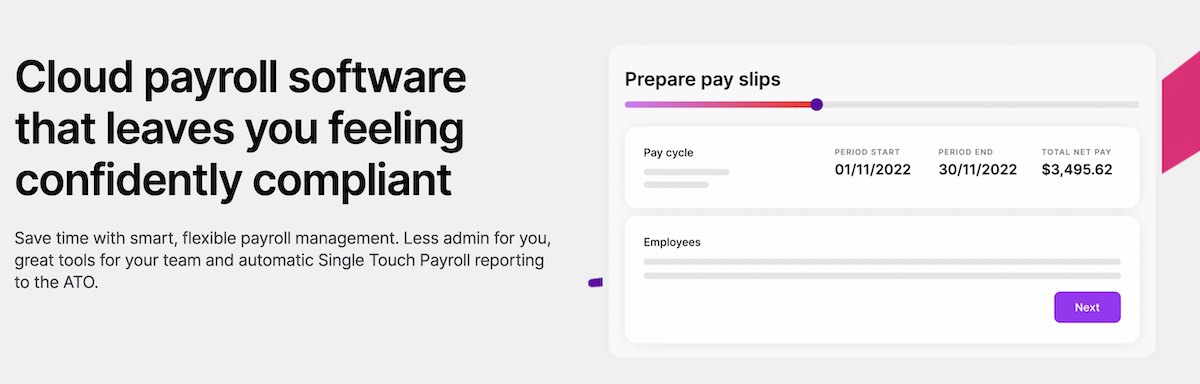
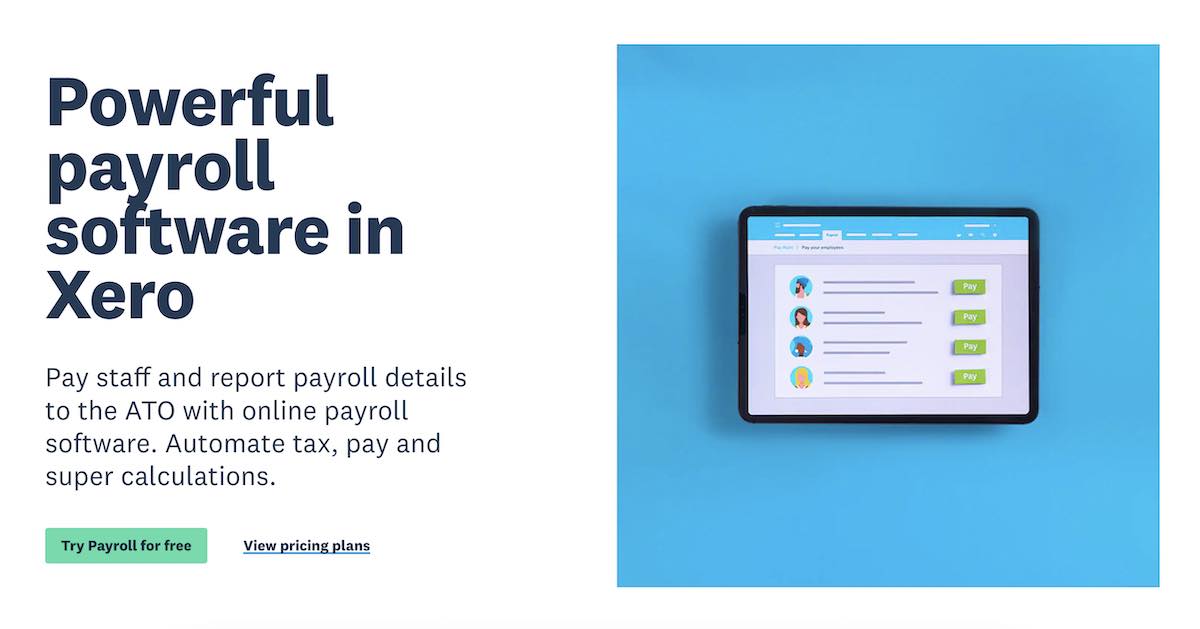
xero payroll software

Pros Cons
User-friendly interface Limited support (Live desk help)
Inexpensive for sole traders and small businesses Lack of flexibility to manage annual leave accrual dates separately from employment start dates
Manages both non-GST and GST-registered workers and withholding tax in the same system Primarily an accounting software with some payroll features
Free trial

Pricing: Monthly plans are between $29-$110 AUD

Visory integration: Yes

Best for: Sole traders and small businesses that manage accounting and payroll in one platform

2. Employment Hero

Employment Hero is a versatile payroll software combining payroll, HR, and employee benefits management into a single platform. It offers comprehensive features, including: 

  • Automatic pay runs
  • Payroll reporting
  • Timesheet tracking
  • Leave management
  • Employee onboarding
  • Compliance management 

The intuitive user interface makes it easy to navigate. Employment Hero also acquire KeyPay, so it’s easier to effectively manage your workforce and payroll all in one centralised solution. They’ve also recently introduced AI features that can help automate processes and save time.

employment hero payroll


Pros Cons
Free 14-day trial It focuses on HR and payroll, so you’ll need a separate bookkeeping and accounting software
User-friendly
The mobile app assists the employee in requesting time off and tracking pay stubs

Pricing: Plans range between $5- $7 AUD per employee per month

Visory integration: Yes

Best for: Growing businesses that want complete payroll and HR solutions

3. MYOB

MYOB is a comprehensive payroll solution for businesses of all sizes. Notable payroll features include: 

  • Automated pay runs
  • Tax and superannuation calculations
  • Real-time expense reports and budgets
  • Timesheet management
  • STP reporting

myob payroll

With MYOB’s customisability, you can personalise the software to suit your specific payroll requirements, making it a reliable and efficient choice for managing payroll effectively.

Pros Cons
Useful for basic accounting The interfaces isn’t as user-friendly as others 
Easy and quick to extract data
Free trial

Pricing: Monthly plans are between $30 – $170 AUD

Visory integration: Yes

Best for: Growing businesses with many employees

4. Deel

Deel is an ideal payroll software for businesses with global, remote teams and contractors. 

Its features include: 

  • Automated onboarding
  • Time tracking
  • HR management
  • Contractor management
  • Compliance reporting
  • Deduction management

What sets Deel apart is its capability to handle payments for contractors in different countries and currencies.

deel payroll software

Pros Cons
Quick and easy setup Limited invoice customisation
Add-ons available for global payroll Complicated contract templates
Mobile app for employees to quickly access their pay stubs, time off requests, and other information Pricing is per contractor, so the cost increases with workforce size
Only enterprise subscribers are eligible for CSMs
Lack employee support

Pricing: Monthly plans range from $0 – $599 AUD

Best for: Businesses that work with many contractors and global, remote workers.

5. Gusto

If you’re a small business owner, Gusto is an all-in-one HR, payroll, and benefits software you’ll love. It simplifies employee onboarding, time tracking, and automatic tax filing. 

gusto

What’s impressive about Gusto’s payroll software is its flexibility. It can handle payroll for full-time, part-time, and contract workers. 

Pros Cons
Easy to use for employers and employees It doesn’t offer any accounting features
Unlimited payroll runs It doesn’t have billing features
Integrates seamlessly with other software, such as accounting and time-tracking solutions Dedicated support is only available for premium
Basic reports are available in all tiers Ideal for small businesses and startups but not large organisations

Pricing: Monthly plans start $40+ $6 AUD per person

Visory integration: Yes

6. Quickbooks Payroll

Quickbooks is a popular, cloud-based accounting software for small and medium businesses. 

You can send customisable invoices and manage inventory, accounts payable (AP), and accounts receivable (AR). 

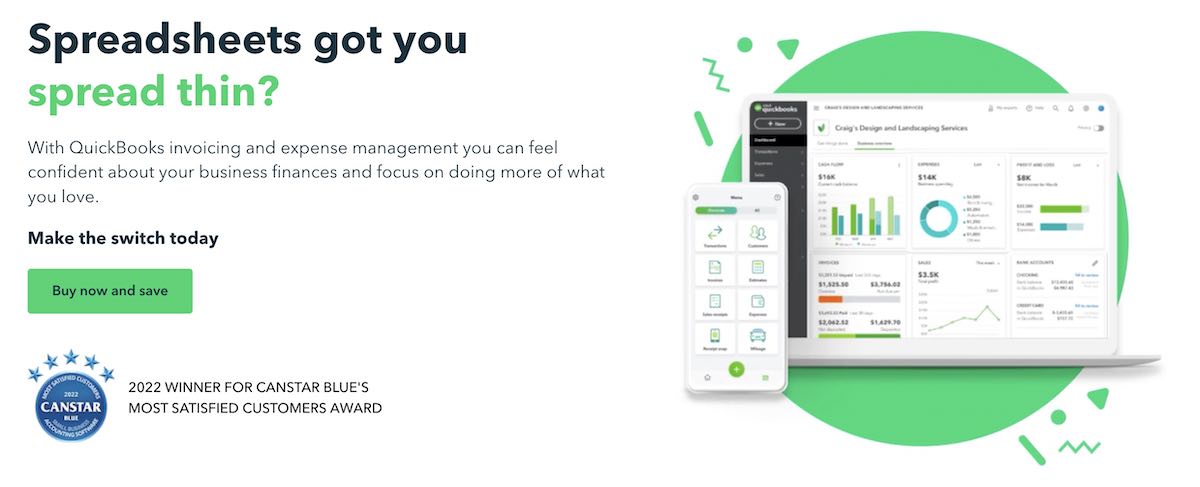
quickbooks payroll

Quickbooks is primarily an accounting software. Its payroll solution is actually powered by Employment Hero. 

Pros Cons
30 days free trial Expensive subscription
50% off discounts for the first three months Limited support for lower tiers
STP compliant More of an accounting software than payroll
Easy set up

Pricing: Monthly plans range between $25 – $55 AUD 

Visory integration: Yes

Best for: Sole traders and small businesses with limited payroll needs

7. Paytron 

Paytron is a payroll and bill payment software available in 180 countries and can make payments globally within the same day. It can help you seamlessly manage accounts payable and accounts receivable with workflow automation and approval tools. 

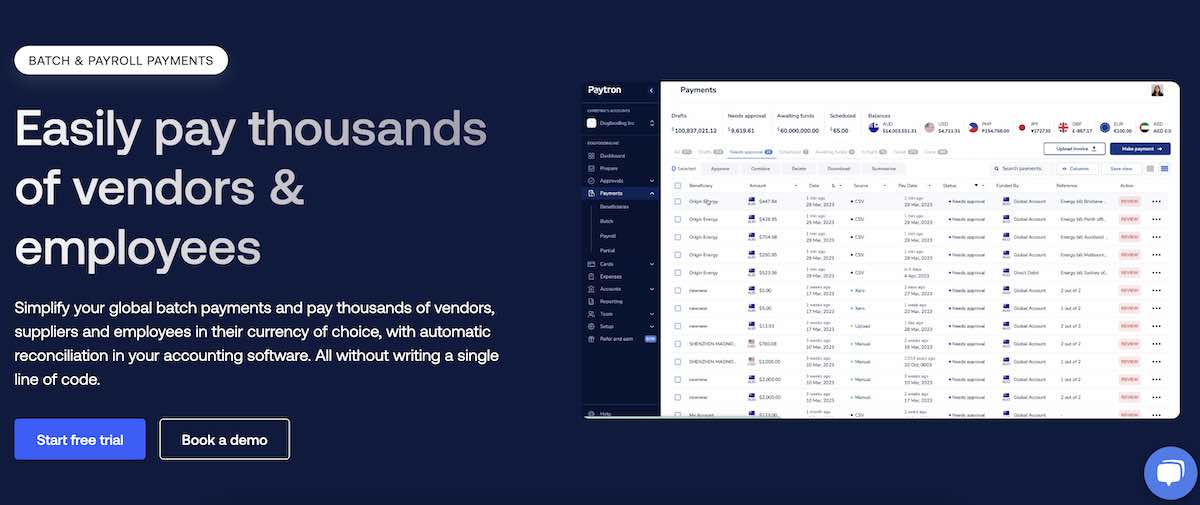
paytron

Other features of Paytron payroll are:

  • Automated invoice management
  • Batch payments for vendors and employees
  • Virtual card management for expenses

Paytron integrates with Employment Hero. You can make payroll payments within a secure encrypted connection with just one click. Small, mid, and large businesses use Paytron, but it’s not a complete payroll solution. 

Pros Cons
24/7 live support  Not a complete payroll software. It helps you make payroll payments.
One-click payroll processing The lowest package has minimal features
Integration with Xero, KeyPay, and Employment Hero

Pricing: Monthly plans start at $125 AUD 

Best for: Managing payments in combination with another payroll software

Best payroll software for your business

Choosing the right payroll software for your business can make paying and managing your workforce easier. It can save time for HR teams and prevent payroll errors.

Evaluating factors such as cost, features, user interface, and integration capabilities can help you decide which is the best option for your business.

If you’re looking for a reliable payroll solution, consider outsourcing your payroll processing to Visory. Certified and vetted bookkeepers and payroll experts provide fast and accurate payroll processing services to businesses in Australia and New Zealand. Whether you’re a small business or a large enterprise, our cloud-based system can help you manage your payroll with ease. Contact Visory today to get started.

Everything to know about small business payroll

Small business payroll may seem simple at first, but as your payroll needs grow, the process becomes more complex. Although you may view this complexity as a headache, it’s actually a great sign—your business is growing. 

You’ll need more staff and with that, means more payroll tasks and responsibilities. Many small businesses and SMEs outsource payroll services to save time and money. But, understanding how small business payroll works and what you need to do, can help you get started. When it’s time to outsource, you’ll also know what to look for in a payroll provider.

Getting started with payroll

If your business has hired employees before, you’re probably familiar with payroll. However, payroll also involves a lot of moving parts and compliance standards. 

As mentioned above, payroll can become complicated for growing businesses. After all, you have to consider income tax, superannuation, award rates, salary sacrificing, and more to get it all right.

Here are a few core responsibilities and considerations you have when managing payroll. 

  • Hiring staff as an employee or a contractor – you’ll need to run payroll for employees where contractors invoice for their time. 
  • Records you need to keep – you’ll need to record personal information, track awards rates, hours worked and more. 
  • Payroll withholdings – are you meeting superannuation guarantees, income tax, HECs repayments and other payroll requirements?
  • Type of payroll software to use – Using the right software helps you automate time tracking, meet compliance standards and integrate with your existing accounting software.
  • Payroll services – outsourcing payroll to a trusted third party can save you time and money while making sure you meet compliance requirements.

In addition to these basic requirements, you’ll also need to be aware of payroll compliance.

Requirements for payroll compliance

To operate a business in Australia, you need to maintain compliance with payroll regulations. For example, there are several National Employment Standards (NES).

They include:

  • Flexible working arrangements – Employees may request flexible working arrangements after working with the same employer for at least one year. 
  • Maximum hours – Full-time employees have 38 working hours plus reasonable additional hours. 
  • Parental leave – Employees with a newborn or adopted child have up to 12 months of unpaid leave. If the employee chooses, they can request an additional 12 months of leave. 
  • Annual leave – All employees must receive at least four weeks of annual leave, and for some shift workers, it’s five weeks. This requirement doesn’t apply to casual workers. 
  • Personal or carer’s leave and compassionate leave – This gives employees 10 days of paid leave, two days of unpaid carer’s leave, and two days of compassionate leave. However, casual workers are unpaid. 
  • Public holidays – Employees get paid days off on recognised public holidays.

Along with NES, small businesses must also keep employee payroll records and payslips. To be compliant, you must keep records for up to seven years. You also need to send and maintain payslips to show you’ve paid the right wages and entitlements.

Payroll withholding and taxes

Employers must withhold income taxes from their employees’ paychecks. The rate at which you’ll need to withhold income taxes largely depends on the amount of money each employee earns. Find more details on income tax rates in Australia below. 

Moreover, Australia charges employers who pay $6.5 million or less in taxable wages a 4.75% payroll tax. Companies that pay more than $6.5 million pay a 4.95% payroll tax. 

Income taxes

Australia’s national income tax rates range from 0% to 45%, depending on the amount of income the employee generates. Here’s a breakdown of the typical tax rates:

Annual Income Taxes
Up to $18,200 0%
$18,201 – $45,000 19%
$45,001 – $120,000 32.5%
$120,001 – $180,000 37%
$180,001 and over 45%

How to pay payroll taxes

To make payroll tax payments to the ATO, you’ll need to register your PAYG. Once you do, you’ll be able to make your payroll tax payments online. Keep in mind that you’ll need to regularly make your payments and report the payroll taxes you’ve withheld from your employees. 

Other tax considerations

There are other considerations to think about when handling your small business payroll. After all, income tax isn’t the only part you’ll withhold. 

You’ll also need to withhold superannuation—a required portion that goes toward retirement. It’s at least 10.5% of each employee’s gross income, but it’s much more complex than that. Most of the mistakes that businesses make when doing their own payroll are related to superannuation, so it can be worth seeking an expert.

Tips for setting up and managing payroll

Your business is growing and you’re ready to make your first hire. Before you do, you’ll need to set up your payroll. Here’s what you’ll need to get started:

  • ABN – As an employer, you’ll need to get your Australian business number or ABN. If you already have one, you’re one step ahead. 
  • PAYG – Next, register for pay-as-you-go withholding, also known as PAYG. 
  • Gather employee information – You’ll need your employee’s Tax File Number (TFN) as well as their superannuation and bank details.

1. Register your ABN and PAYG withholding

Before you hire your first employee, you’ll register your ABN with PAYG withholding. This is where you’ll pay the money you withheld to the Australian Tax Office (ATO). 

2. Collect employee information 

Next, be sure to collect your employee’s information and check that information for accuracy. You’ll need:

  • Identification – You need to verify your employee’s identification. Be sure to make a copy of their identification card for your records. 
  • TFN – You’ll also need your employee’s Tax File Number (TFN). 
  • Superannuation and bank details – Finally, you’ll need to get your employee’s Superannuation details as well as their bank details. 
  • Withholding declaration – This authorises you to adjust the amount of tax withheld from final payments.
  • Medicare Levy declaration – This will impact payroll as an additional tax on employee income that you may need to pay

3. Use single-touch payroll

The ATO incorporated single-touch payroll (STP) in 2018 to find businesses that aren’t paying their employees correctly and improve tax reporting efficiency. 

To use single-touch payroll, your accounting or payroll software will need to integrate with a Transport Provider. From there, the Transport Provider securely sends the required data to the ATO in the STP format. 

4. Choose the right payroll software 

There are several different types of payroll software available. The software you choose will determine if payroll is a simple process or a constant source of headaches. When you choose your software, consider regulatory compliance, the tools the software has to make your life easier, STP capabilities, and other integrations. 

Visory integrates with a range of major industry software for payroll services. However, it’s important to note that software is only one part of doing payroll. Sure, it can make the job easier, but it doesn’t automate the payroll process. A payroll expert should still review your records to make sure it’s accurate. 

5. Leverage payroll services 

When it comes to managing payroll on time and accurately, it’s wise to work with an outsourced payroll service provider. A payroll provider will make sure your payroll process is compliant and accurate. They’ll free up time for you to focus on more important areas of your business and reduce the risk of future issues.

Your business is growing, and with that comes a need for a better payroll process. Bookkeepers also often provide payroll services, and with the right provider, you can get bookkeeping and payroll all in one. If you’re ready to get help managing your payroll, find out how Visory can help.  


What’s the Difference Between Payroll and Bookkeeping?

No business gets far without sound financial infrastructure. Up-to-date and accurate payroll, bookkeeping and accounting practices help set the foundation of a successful business. So, it is important to understand the difference between payroll and bookkeeping and how, along with accounting, they contribute to your financial health. 

Software has simplified parts of the process, but it has not fully automated bookkeeping, payroll, and accounting tasks. Whether it’s an error preparing payroll payment register summaries or distributing payslips, any glitch can throw financial records off, so it’s important to hire the right expert.

Although many bookkeepers do payroll, by no means are all bookkeepers payroll experts. At Visory, we have a separate payroll team taking over these responsibilities. 

In this guide, we’ll go over the basics of payroll, bookkeeping and accounting. We’ll outline the tasks each may do, and the role each plays in your business. 

What Does a Payroll Expert Do? 

Payroll is the process of verifying and distributing payments to employees at the agreed rate and in accordance with designated award rates. The process might appear straightforward and easily automated, however, it’s an easily tangled process that can require skilled financial experts as well as Human Resources to ensure it is completed without issue.

Payroll Tasks

The tasks that a payroll expert completes may vary slightly depending on if you’re outsourcing payroll or hiring in-house. It also depends on the details of your service agreement. However, these are a few of the common tasks and responsibilities. 

  • Make sure all payroll transactions get processed efficiently and at the correct times
  • Calculate, collect, and record data to manage and track payroll information and balance sheets
  • Compile summaries of earnings, deductions, disabilities, taxes, benefits, leave, and non-taxable earnings for financial statements, audits, and more
  • Resolve payroll discrepancies
  • Follow regulatory payroll policies and procedural operations for compliance
  • Manage PAYG withholding
  • Reconcile payroll tax 
  • Set up single-touch payroll
  • Note total gross award rates of the payment register YTD report
  • Contribute to superannuation funds on behalf of employees
  • Implement ad hoc operational and financial reporting as required

Payroll Checklist

To keep payroll accurate, businesses need to collect and confirm employee details like those listed below. 

  • Have confirmed employee details
  • Legal name and address 
  • Date of birth 
  • Tax file number
  • Start (and termination date) of every employee
  • Details of account they want used to receive wages
  • Track pay details such as allowances, gross wage, hourly award, etc.

What a Bookkeeper Does

Bookkeepers manage many of the everyday financial needs of a business, from tracking cash flow and reconciling your accounts to updating your books and creating standard financial reports. 

Although bookkeepers are not the same as accountants or payroll experts, occasionally, a bookkeeper may perform some payroll or accounting tasks. Although, it is important to note that performing actions like lodging a tax return requires additional certification, such as becoming a BAS agent. If you’re considering hiring a bookkeeper, consider what types of tasks you need and their area of expertise. 

Bookkeeper Tasks

Here are a few common tasks bookkeepers may handle.

  • Pay suppliers, vendors, subcontractors, etc.
  • Produce, record, and track invoices for provided services or goods sent to clients
  • Bank reconciliations
  • Document customer receipts
  • Prepare financial reports like balance sheets 
  • Manage accounts receivable and payable
  • Track depreciation

What’s the Difference Between Payroll and Bookkeeping? 

Although a bookkeeper may complete some payroll functions, the two roles are different. Now that we’ve covered each in detail, let’s look at how they differ. 

In their most basic form, payroll and bookkeeping are different because they manage different functions within an organization. 

  • Payroll: The process for paying and managing award rates to staff.
  • Bookkeeping: The day-to-day management of the company’s finances.

Accounting is also sometimes used interchangeably with payroll and bookkeeping. It is key to understand these differences as well, especially if you are considering hiring an expert to help you with your business finances. 

What an Accountant Does

Accountants are advisers who produce financial reports and offer financial advice. They prepare tax returns and ensure taxes get paid on time and properly. So that the business is stable, accountants evaluate operations and recommend best practices, spot issues, and develop solutions to help the organisation run more effectively.

Accountant Tasks

Here is a brief list of many tasks an accountant might be responsible for daily.

  • Ensure the accuracy of the company’s accounting tax records
  • Make sure any financial transaction complies with relevant laws and regulations such as the Corporations Act
  • Prepare, report, and maintain important financial reports
  • Put together tax returns and see that taxes get paid properly and on time
  • Offer counsel on revenue enhancement, cost reduction, and profit maximization
  • Assess forecasting and risk analysis 

Why You Need Payroll and Bookkeeping Experts

An error in your financial records can impact your entire operation and knock the business off its game. A skilled bookkeeper can help you strengthen your business acumen, whether that be choosing the right bookkeeping software or analysing your financial data to identify areas of growth. 

With Visory, you can be confident that your bookkeeping and payroll system is efficient, effective, and agile.

As professionals, we know small errors turn into large problems so we scrutinise every line to ensure accuracy. 

Whether you are an international enterprise or a growing business, managing payroll and bookkeeping on your own can feel like a daunting task. Visory’s team of experts understands the differences between payroll and bookkeeping and can help you assess what your business needs. If you’d like to learn more about identifying the best ways to improve back-office practices, contact Visory today.

Benefits of Using Outsourced Payroll Providers

Outsourcing your payroll involves working with a third-party provider to streamline your payroll tasks and process. Outsourced payroll providers leverage expertise and technology to help you complete these tasks quickly and accurately.

You don’t have to manually work out the calculations or handle the administrative activities yourself. Outsourcing simplifies the process to reduce the stress associated with payroll tasks. 

To decide whether payroll outsourcing is right for you, let’s dive deeper into the benefits of using outsourced payroll providers in your business. 

Top 6 Advantages of Using Outsourced Payroll Providers

Using outsourced payroll providers in your business has dozens of benefits. But here are the top six. 

1. It Can Save Time and Boost Productivity in Your Business

Regardless of the number of employees in a business, payroll tasks can consume a great deal of time. For example, you must accurately track employees’ benefits, deduct applicable taxes, and send payslips to employees. Considering that you have other business activities, these tasks can be tiresome and time-consuming. 

However, outsourcing payroll processes to a reliable third-party provider leaves you with less work. As a result, you get extra time to focus on strategic tasks that take your business to the next level. For instance, the time and effort you’re using right now in payroll procedures can be re-channelled to streamline customer service and improve your business’ online presence. 

2. It Can Reduce Labor Costs 

Giant enterprises have the financial power to maintain reliable payroll departments. However, in-house payroll procedures are a money burner for small/medium-sized businesses. If you outsource, you can save a lot of money. Here’s a quick comparison you should do right now. 

Identify how much you spend on employees who handle payroll-related activities. Then, compare the amount with the pricing plans of an outsourced payroll provider to see how much you’ll save. 

3. You’ll Reduce Compliance Risks in Your Business and Potentially Avoid Paying Penalties

According to the Australian Taxation Office, as an employer you are responsible for taking care of your annual tax liabilities. Otherwise, your business may face penalties for neglecting legal obligations. The penalties often come from calculation errors, failing to file payroll tax statements on time, and deducting less than the law requires. 

Small business owners are susceptible to these mistakes because they aren’t experts in the world of complex and ever-changing tax regulations. The good news is that outsourced payroll providers can help you stay on top of tax requirements. 

After all, they have the skills, resources, and experience to calculate values accurately and file taxes on time. Eventually, you comply with government regulations and potentially avoid penalties that hurt productivity in businesses. 

4. You’ll Gain Access to Advanced Technology

With outsourced payroll service providers, you can access powerful technology that takes your business to the next level. For example, reliable third-party providers use robust payroll software programs, bookkeeping applications, and Human Resource Information Systems to offer multiple solutions.

As a result, you eliminate technology advancement costs in your business. You’ll forget the hassle of frequently updating payroll software applications to the latest versions. Even better, you’ll avoid regularly adjusting in-house technology to fit the most recent payroll tax tables. 

In short, third-party providers have the modern tools you need to keep your payroll running smoothly. 

5. It Improves Data Security in Your Business

Statistics say that 43% of cybercrimes target small businesses. That said, how safe is the payroll data in your in-house computer network? Do you have sufficient resources to future-proof your technology against malicious cyber-attacks? 

Outsourced payroll providers place measures that secure your payroll data against cybercriminals. For example, they use backup technologies and multiple server locations to streamline business operations in case of a cyber breach. Third-party providers also leverage powerful anti-malware technology to detect unethical activities before they bring disaster to your business. 

6. You’ll Access Accurate Reports for In-House and Accountant Use

Small businesses usually have less time to focus on payroll tasks, increasing the chances of mistakes. Outsourced payroll providers give you access to a reliable team that solely focuses on streamlining payroll tasks to enhance accurate reporting. With accurate reports, you can make data-driven business decisions. 

How to Choose an Outsourced Payroll Provider

You need to consider the following factors to help you choose the right payroll service provider. 

How Accurate Is the Outsourced Payroll Provider? 

Accuracy is a crucial factor when choosing a payroll provider. After all, what’s the point of paying for services causing wrong payroll tax calculations and inaccurate employee wages? 

Make sure you only partner with a skilled and experienced third party. Check the provider’s existence period in the industry, the methods they use to handle your payroll, and customer reviews (or case studies) on their websites. 

Does the Payroll Provider Offer Customised Packages? 

Basic payroll packages may work for now, but what happens when your business grows? The truth is that your compliance and payroll needs increase as your organisation grows. Therefore, you need a personalised payroll services package that grows with your business. 

Does the Payroll Provider Guarantee Data Security? 

Payroll data is super sensitive since it entails personal information. For this reason, ensure the third-party payroll provider has stringent cyber security policies put in place. 

For example, you need a payroll provider with data-backup solutions to avoid downtime in the case of a cyber breach. 

What’s the Cost of Hiring the Payroll Provider? 

Payroll outsourcing costs less than hiring an entire in-house team. However, ensure the provider doesn’t have any hidden charges. 

Why Outsource Your Payroll Processes to Visory? 

At Visory, we combine data, business processes, and people to bring you the best payroll services. The following factors make us stand out in the industry. 

  • We offer secure payroll services in Australia and abroad. Our cloud-based platforms operate under stringent cybersecurity measures to ensure your payroll data is safe. Our skilled professional team also manages your payroll to avoid data breaches. 
  • We reliably handle all your payroll tasks. That way, you get extra time to focus on core business activities that increase profit in your business. 
  • Accurate reporting. Calculation errors are the primary cause of payroll-related penalties. Our payroll experts are here to help eliminate errors and increase accuracy in your payroll tasks. 
  • Our prices are affordable. Each package we offer is only a fraction of the cost of hiring an entire in-house team. Plus, we have a custom pricing plan that ensures you only pay affordable prices for the services you’ll get. 

Learn More about how Visory can save you time and take your payroll process to the next level.

Why You Should Outsource Your Payroll Process

An expanding organisation outgrows many things over time. This might include working out of your home, printing your own adverts, and handling your own payroll processing. You can save a lot of time and energy by handing over your payroll to a trusted partner. 

Once you’re large enough, you may be able to create an entire in-house payroll department. But what about that stage where you don’t have the resources for full-time payroll staff but can’t keep asking executives to cut cheques? You outsource payroll. 

Let’s talk about the benefits of outsourcing your payroll service, and what virtual bookkeeping for professional services looks like in practice. Spoiler: tax time will be easier. 

How Does Payroll Outsourcing Work?

Before you entrust someone else to run payroll for your business, you want to know what they can handle. A virtual bookkeeping service may be your best option. You’ll have access to an experienced team that can tailor their services to your exact needs. 

When you outsource payroll, you’ll either give your contractor access to your payroll software or allow them to set it up for you. You’ll never have to worry about late paychecks again. 

Which services do payroll outsourcing providers offer?

It’s easy for a payroll period to sneak up on you. And if you enter tax information incorrectly, both you and your employee could be in some trouble at the end of the year. When you hand over payroll to a partner, they can:

  • Make sure the correct taxes are taken out. You and your employee will appreciate an accurate accounting of payroll taxes when it’s time to lodge your returns. 
  • Get forms signed. When a new employee comes on board, it’s important to get their documents sorted promptly and correctly. Your outsourced payroll partner can tackle these details. 
  • Handle benefits. If your employee takes a sick day or paid time off, you can trust your virtual payroll service to properly note it. 
  • Track time. If your staff are required to track their time throughout the week, a payroll service can handle it. Then, they translate the hours to the appropriate paycheck. 
  • Send funds. Perhaps most importantly, your payroll source can become accounts payable, ensuring that all employees are paid on time each pay period. You won’t have to rush to send off direct deposit money or paper cheques again. 

Benefits of Outsourcing Your Payroll Process

There are many reasons to outsource payroll. Maybe you’re just not great with numbers or you are becoming overwhelmed with other aspects of your business. While you’re seeking help with

online bookkeeping, it makes sense to sign up for payroll services. Here are just a few of the benefits. 

Save Time and Energy

You will have more time to focus on research and development, marketing, hiring and a host of other vital activities with payroll off your plate. You may not realise just how much of your energy is going toward calculating benefits and dealing with running payroll until you let someone else take over. 

Minimize Payroll Mistakes

Payroll mistakes can leave your employees in the lurch — a late payment could mean they can’t pay their bills. On the other hand, overpaying or forgetting to add vacation time could cost your company money. Financial mistakes are never good. What’s more, a mistake that doesn’t get corrected once could continue each pay cycle, including incorrect tax deductions. Leaving payroll to the pros will reduce the number of errors. 

Improve Your Data Security

Your employees entrust you with sensitive information, including bank details, when they submit payroll documents. When you outsource payroll you can increase peace of mind. Payroll experts know how to guard important personal data. 

Reduced Costs

Payroll mistakes can get very expensive. So is hiring someone full time, especially if you are still a small-to-medium size business. Paying a contractor may be a more cost effective way to get your payroll done promptly. 

Help Filing Payroll Taxes

Your payroll contractor can also ensure that your taxes are lodged the right way. This can mean you avoid fees during tax time and save your employees from explaining why they underpaid. Tax rules change often; you won’t have to stay on top of the tax code when you have an expert on the case. 

Maintain Compliance

Payroll assistance also keeps your business compliant with any financial reporting or payroll laws for your industry. Regulatory compliance may be required at the state or national level. Hand it over to your outsourced payroll provide so you don’t have to make heads or tails of complicated compliance rules. 

When is it Time to Outsource Payroll?

If any of these signs sound familiar, it may be time to get some help with your payroll. 

  • You are growing as an organisation. If you’re the founder of a company, it’s natural to outsource services as you scale up. 
  • You missed a payroll period. If you’ve ever gotten so caught up in other work that you forgot to pay an employee, you should call in reinforcements. 
  • Your finances are becoming complicated. Whether due to growth or other causes, if your accounts receivable is already keeping you up at night, why not take payroll off your plate?
  • You are hiring for the first time. You may have a small trusted group of people in your company for the first several years. As you hire from the outside to add to your team, you should also bring on a payroll pro.

Deciding to outsource payroll is a wise move for many businesses. Whether you are growing as a company or just confused about tax deductions, an outsourced payroll professional will be a lifesaver. You can focus your attention on things like marketing and rest easy knowing your paychecks are going out like clockwork. 

A company like Visory will pair you with a team of payroll experts. They will know your industry and allow you to add more services as needed. Before you know it, your outsourced payroll team member will be a trusted extension of your company.